





















































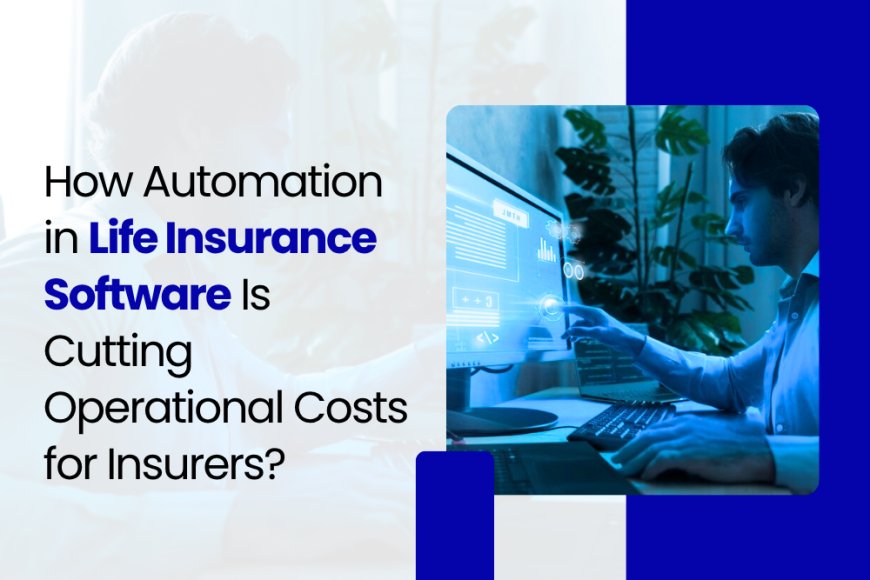
How Automation in Life Insurance Software Is Cutting Operational Costs for Insurers?
Automation in life insurance software helps insurance companies streamline operations, reduce costs, and improve service delivery.

Automation is an advanced insurance software solution that handles routine key-stroke level tasks. From underwriting to claims processing, automation transforms how insurance companies run, cutting costs without compromising on service or compliance. By removing manual processes and increasing accuracy, insurers are gaining efficiency, saving money, and delivering faster service.
Automation streamlines everyday workflows that drain workers time. It frees up employees from manual tasks and diverts them to focus on more strategic operations. Several case studies have suggested a significant 200% increase in ROI after the implementation of automation in insurance software. Insurtech plays a crucial role in automating claim processes, leading to more efficient and accurate handling of claims. By leveraging advanced technologies like artificial intelligence and automated workflows, insurance companies can significantly reduce the time and costs associated with claims processing.
Insurance Business Operations Need Evolution
However, insurance companies still running on legacy systems are crumbling under the weight of digital demands, data volume, and rising service expectations. Additionally, delays in claims processes done manually are affecting the overall customer experience. Hence, it has become important for the insurance business to deploy automation.
Automation in insurance is a holistic solution for its complete digital transformation. Modern insurance software equipped with the right tools helps insurers shed outdated, high-cost workflows and adopt streamlined, automated processes that reduce errors and operating expenses.
Where Insurance Software Automation Creates Maximum Impact
Automation Cuts Costs in Claims Processing
Processing claims in insurance is a complex task. Insurers cannot afford any error in this phase as it can bleed an organization. Many insurance companies with legacy systems are struggling with the inefficiencies that involve manual data gathering, document verification, fraud checks, and endless back-and-forth between departments. It not only frustrates policyholders but also drives up the administrative cost per claim.
Insurers can eliminate such bottlenecks by integrating automation within insurance software solutions. Accenture reports a 40% reduction in claims handling costs when automation tools are implemented correctly. Automation enables real-time insights into data to efficiently submit documents, auto-validate against policy terms, and quickly identification of low-risk claims that can be settled within minutes. The net effect is a significant drop in claims processing costs, improved customer satisfaction, and a streamlined system that scales without requiring equivalent increases in workforce.
Automation Turns Manual Underwriting Process into a Strategic Approach
Underwriters analyze the risk profiles and medical histories of each individual. It is a time-consuming process. The sheer volume of low-risk applications creates an operational load that slows down issuance and inflates costs. Life insurance software equipped with automation enables underwriters to assess each case efficiently and quickly. Applications that meet certain criteria can be approved instantly, which reduces time-to-issue from days to minutes. Automation in underwriting uses predefined business rules and AI-powered decision engines to instantly assess eligibility and determine premiums.
A Swiss insurance company Swiss Re stated that after deploying automation they have seen a nearly 50% reduction in underwriting costs. Thats a dramatic efficiency gain for high-volume insurers.
Automating Regulatory Compliance and Reporting to Avoid Penalties
Life insurance is one of the most heavily regulated industries in the world. They need to remain compliant with evolving regional and global regulations. For insurers relying on legacy systems, manual compliance tracking, auditing, and reporting drain resources and increase the risk of oversight. However, insurance software embedded with compliance modules maintains audit trails, generates regulatory reports, and ensures data privacy protocols. Additionally, automation ensures that compliance becomes an in-built feature.
This way, insurance companies can reduce legal costs, prevent hefty penalties, and create long-term savings by removing the need for dedicated teams solely managing regulations.
Minimizing IT Infrastructure Costs Through Cloud-Based Automation
A report by Gartner states that cloud automation can reduce infrastructure expenses by 20-30% annually. It is one of the reasons that insurance companies are shifting from legacy systems to digitized software solutions. Moreover, maintaining legacy systems is expensive due to its high maintenance costs, complex integrations, and heavy infrastructure investment. So, when an insurance company move to cloud-based software for life insurance operations, the system reduces the overall cost. This modern solution automatically updates, provides real-time support, cuts IT support costs, and ensures agility. Furthermore, cloud automation allows different departments, from underwriting to claims, and billing, to work on a unified platform. It reduces the inefficiencies and costs associated with siloed systems.
Data-Driven Decision-Making Lowers Strategic Risk and Cost Overruns
Manual data entry is not just time-consuming, but also error-prone. A small mistake can lead to compliance issues or poor customer experiences. Automation helps store and retrieve data when required which further helps improve strategic decision-making.IBM research shows that automated data processes can boost accuracy by more than 80%. Automation-embedded insurance software collects, integrates, and analyzes operational data across every department. Insurers can view real-time dashboards, monitor KPIs, and forecast trends as well. This leads to better decision-making regarding pricing, risk detection, sales strategies, and customer expectations.
In A Nutshell
Embedding automation in insurance software empowers insurance companies to thrive in a competitive market. It enables firms to automate their operations which further reduces errors, time, and costs. From claim automation to policy administration, compliance, IT, and data insights- each automated process trims away the inefficiencies that have quietly drained insurers for decades. As operational costs keep rising, companies that embrace automation will lead.